
If you have searched for “apposed vs opposed,” you are probably trying to understand why these two words look and sound so similar but have very different meanings. The difference is important because using the wrong word can change the meaning of a sentence completely.
The simplest explanation is this:
- “Opposed” means against something, in disagreement with it, or in conflict with it.
- “Apposed” means placed next to, against, or side by side with something. It is used more often in medical, scientific, anatomical, and technical writing.
For example, “She is opposed to the proposal” means she does not support the proposal. In contrast, “The two surfaces are apposed” means the surfaces are positioned next to or against each other.
This guide explains “apposed vs opposed” in simple English. It covers their definitions, pronunciation, grammar, origins, examples, common mistakes, medical usage, technical meaning, and practical ways to remember the difference.
What Does “Opposed” Mean?
“Opposed” is the past participle and adjective form of the verb “oppose.” It generally means being against something or disagreeing with something.
When a person, group, idea, or position is opposed to something, it does not support it.
For example:
- Many residents are opposed to the new rule.
- She was strongly opposed to the decision.
- The organization is opposed to unnecessary restrictions.
- He opposed the plan during the meeting.
In everyday American English, “opposed” is much more common than “apposed.”
The word can describe disagreement with an opinion, policy, proposal, action, person, or decision. It can also describe two things that are positioned against each other in a broader sense.
Simple definition of opposed
“Opposed” means:
Against, disagreeing with, or not supporting something.
This is the meaning most people need when using the word in everyday conversation and writing.
What Does “Apposed” Mean?
“Apposed” is a less common word. It comes from the verb “appose,” which means to place something next to or against something else.
The idea is physical position rather than disagreement.
For example:
- The two surfaces were apposed.
- The edges were carefully apposed during the procedure.
- The tissue layers were apposed to promote proper healing.
The word appears especially in medical, anatomical, biological, and technical writing.
In these contexts, “apposed” describes things that are touching, positioned close together, or brought into contact.
Simple definition of apposed
“Apposed” means:
Placed next to, against, or in close contact with something else.
This meaning has nothing to do with opposing an idea or disagreeing with someone.
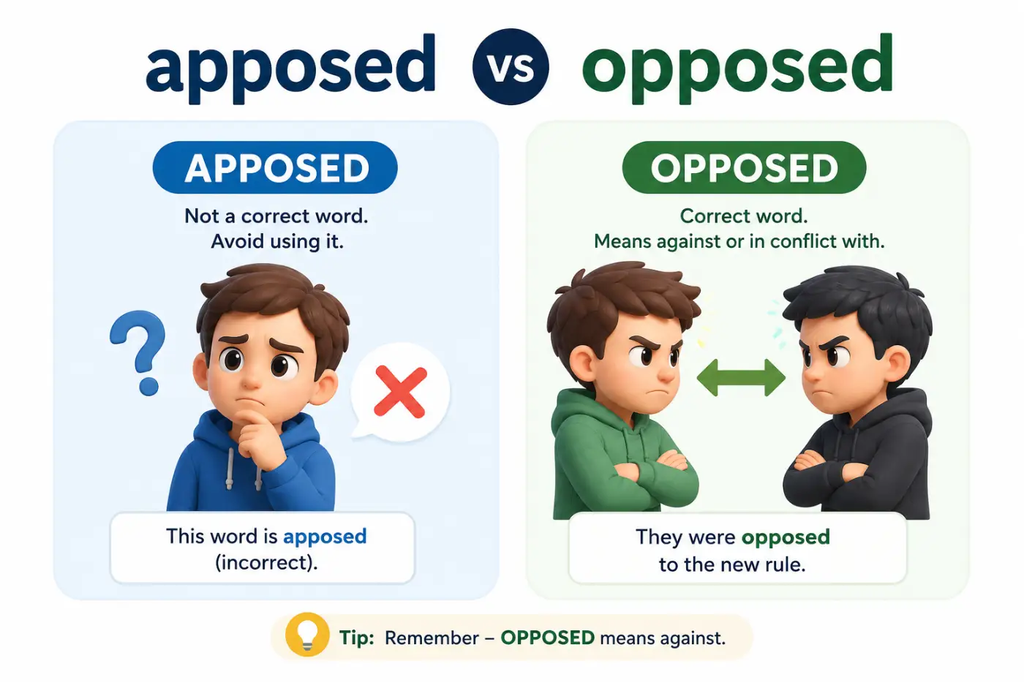
Apposed vs Opposed: The Main Difference
The easiest way to understand “apposed vs opposed” is to focus on the type of relationship being described.
| Word | Basic meaning | Common use |
| Apposed | Placed next to or against | Medical, anatomical, scientific, technical |
| Opposed | Against or in disagreement | Everyday English, opinions, policies, arguments |
Consider these two sentences:
“John is opposed to the proposal.”
This means John does not support the proposal.
“The tissue surfaces are apposed.”
This means the tissue surfaces are positioned against or next to each other.
The words are similar in spelling, but their meanings are different.
A useful memory trick is:
Opposed = against an idea or position.
Apposed = placed against something.
The letter “a” in “apposed” can help you remember physical arrangement or adjacency, while “opposed” is associated with opposition or disagreement.
Is “Apposed” a Real Word?
Yes. “Apposed” is a real English word.
Also Read:TheJavaSea.me Leaks AIO-TLP370: Facts, Risks, and Safety Guide
It is simply much less common than “opposed.”
Some readers may think “apposed” is a spelling mistake because they are much more familiar with “opposed.” However, “apposed” has its own dictionary meaning and is used in specialized fields.
The verb “appose” means to place something next to or against another thing.
The related noun “apposition” can describe the act or state of being placed next to something.
This is especially relevant in anatomy and medicine, where professionals may need precise language to describe the position of tissues, structures, surfaces, or other body parts.
Why Are “Apposed” and “Opposed” Confused?
The confusion is easy to understand.
Both words:
- contain similar letters,
- have similar pronunciations,
- can involve the idea of something being “against” something else,
- and are often followed by descriptions of another object or concept.
However, their meanings developed in different directions.
“Opposed” generally concerns conflict, disagreement, resistance, or lack of support.
“Apposed” generally concerns placement, contact, or adjacency.
The word “against” can create confusion because it can describe both concepts.
For example, if two surfaces are against each other, they may be “apposed.”
If a person is against a proposal, the person is “opposed” to it.
The physical meaning and the figurative meaning are different.
Apposed vs Opposed in Medical Terminology
The difference becomes especially important in medical writing.
Doctors, surgeons, researchers, and other healthcare professionals may use “apposed” to describe structures that are positioned against each other or brought into close contact.
For example, a medical text might say that wound edges were “apposed.”
This means the edges were brought together or positioned closely.
It does not mean that the wound edges “disagreed” with each other.
Why medical language uses “apposed”
Medical terminology often needs to describe physical relationships precisely.
Words such as:
- adjacent,
- attached,
- aligned,
- apposed,
- separated,
- proximal,
- distal,
- superficial,
- and deep
can describe the location or relationship between structures.
“Apposed” is useful when simple words such as “next to” or “touching” are not precise enough for a technical context.
What Does “Wound Edges Apposed” Mean?
“Wound edges apposed” is an example that may appear in medical writing.
It means that the edges of a wound have been brought together or positioned against each other.
For example:
“The wound edges were well apposed.”
In simple English, this means:
“The edges of the wound were brought together properly.”
This use is different from “opposed.”
You would not normally say that wound edges are “opposed” when you mean they have been physically brought together.
In medical terminology, “opposed” can have other specialized meanings depending on context, but “apposed” is the precise word when the intended meaning is physical placement or contact.
Apposed vs Opposed in Anatomy
Anatomy is another area where “apposed” may appear.
Anatomical structures can be described as being apposed when they are positioned close together or in contact.
For example:
“The surfaces are closely apposed.”
This tells the reader about their physical relationship.
It does not express an argument, disagreement, or conflict.
Medical and scientific writing often uses specialized words because precise descriptions can matter.
For a general audience, “next to,” “touching,” or “in contact with” may be easier to understand. In a technical document, however, “apposed” can provide a concise and accurate description.
Apposed vs Opposed Grammar
Understanding the grammar can help prevent mistakes.
“Opposed” comes from “oppose.”
Common forms include:
- oppose
- opposes
- opposed
- opposing
- opposition
Examples:
“She opposes the plan.”
“She opposed the plan.”
“She is opposed to the plan.”
“Apposed” comes from “appose.”
The related forms are much less common:
- appose
- apposes
- apposed
- apposing
- apposition
Examples:
“The surgeon apposed the tissue edges.”
“The tissue edges were apposed.”
Because “appose” is uncommon outside specialized contexts, many people encounter “apposed” mainly in technical or medical texts.
Apposed vs Opposed Pronunciation
The words can also be confusing because their pronunciation is very similar.
“Opposed” is commonly pronounced approximately:
uh-POHZD
“Apposed” is commonly pronounced approximately:
uh-POHZD
Because the pronunciation can be very similar, listening alone may not always help you identify which word is intended.
This makes spelling and context especially important.
If you are writing about disagreement, choose “opposed.”
If you are describing physical positioning in a technical context, “apposed” may be the correct choice.
Apposed vs Opposed Word Origin
Understanding the history of these words can make their difference easier to remember.
“Opposed” comes from “oppose,” which is related to Latin roots associated with placing something against or opposite something else. Over time, the word developed strong meanings involving resistance, disagreement, and conflict.
“Appose” has a different historical development. It is connected with the idea of placing something beside or against another thing.
The two words therefore have related-looking ideas of positioning, but modern English uses them differently.
This is a good example of why English words that look similar cannot always be treated as synonyms.
Is “Apposed” the Opposite of “Opposed”?
No.
This is an important point.
“Apposed” is not simply the opposite of “opposed.”
They are not a standard antonym pair.
“Opposed” generally describes disagreement or resistance.
“Apposed” describes physical placement or adjacency.
Also Read:webinkey.com: A Complete Guide to the Online Content Platform
For example:
- “The committee was opposed to the proposal.”
- “The two surfaces were apposed.”
The words describe different relationships rather than opposite states.
The similarity in spelling can make them look like a positive-versus-negative pair, but that is misleading.
Common Mistakes With Apposed and Opposed
Several mistakes appear frequently because of the similar spelling.
Mistake 1: Using “apposed” for disagreement
Incorrect:
“I am apposed to the new policy.”
Correct:
“I am opposed to the new policy.”
The sentence is about disagreement, so “opposed” is needed.
Mistake 2: Assuming “apposed” is a spelling error
If you see “apposed” in a medical or scientific document, do not automatically assume it is a typo.
It may be intentionally used to describe physical positioning.
For example:
“The wound edges were apposed.”
This can be correct medical terminology.
Mistake 3: Treating the words as synonyms
They are not interchangeable.
Changing one word for the other can change the meaning of a sentence.
Mistake 4: Using specialized vocabulary unnecessarily
Even when “apposed” is technically correct, it may not be the best choice for a general audience.
For example:
“The two surfaces were apposed.”
For a general reader, this may be clearer as:
“The two surfaces were placed against each other.”
The best word depends on the audience and context.
Apposed vs Opposed in Academic and Professional Writing
Word choice becomes especially important in professional writing.
In academic, medical, legal, scientific, and technical documents, a small difference in terminology can affect clarity.
If you are describing a person’s position on an issue, “opposed” is appropriate.
For example:
“The researchers were opposed to the proposed interpretation.”
If you are describing physical structures, “apposed” may be appropriate.
For example:
“The tissue layers were closely apposed.”
Professional writers should not choose a word simply because it looks sophisticated. The word should accurately express the intended meaning.
This is an important principle of clear writing: precision is more valuable than complexity.
Apposed vs Opposed in American English
For readers in the United States, “opposed” is by far the more familiar word.
You will encounter “opposed” frequently in:
- news reporting,
- government documents,
- education,
- business writing,
- political discussions,
- workplace communication,
- legal discussions,
- and everyday conversation.
“Apposed” is much less common and is more likely to appear in specialized writing.
It may occur in:
- medical records,
- anatomy textbooks,
- scientific papers,
- surgical descriptions,
- biology,
- veterinary medicine,
- and other technical fields.
Therefore, if you are writing general American English and are unsure which word to use, ask what you are describing.
If it is an opinion or disagreement, “opposed” is almost certainly the correct choice.
How Context Determines the Correct Word
Context is one of the strongest tools for solving “apposed vs opposed.”
Consider this sentence:
“The board was ___ to the proposal.”
The correct word is “opposed.”
Why?
Because the board has a position or opinion about a proposal.
Now consider:
“The two surfaces were ___.”
The correct word may be “apposed.”
Why?
Because the sentence describes physical positioning.
Here is another comparison:
“The patient was opposed to the treatment.”
This means the patient did not support or agree with the treatment.
“The tissue was apposed to the surrounding structure.”
This describes physical positioning.
The surrounding words provide the clue.
When Should You Use “Opposed”?
Use “opposed” when you mean:
- against an idea,
- against a proposal,
- against a policy,
- against a decision,
- disagreeing,
- resisting,
- or not supporting something.
Examples include:
“The residents were opposed to the development.”
“She was opposed to the decision.”
“The organization is opposed to the proposed change.”
These are normal uses in American English.
When Should You Use “Apposed”?
Use “apposed” when you mean:
- placed next to,
- positioned against,
- brought into contact,
- or physically aligned with another structure.
It is most useful in specialized contexts.
Examples include:
“The wound edges were apposed.”
“The two surfaces were closely apposed.”
“The anatomical structures were apposed.”
For a general audience, you may sometimes choose a simpler phrase such as “placed together,” “next to,” or “in contact.”
Why Precision Matters in Medical Language
Medical language often requires careful distinctions.
Also Read:Crackstube: A Complete Guide to the Digital Information Platform
A word that describes disagreement cannot simply replace a word that describes physical position.
For example, if a medical report says that two structures are “apposed,” the important information is their physical relationship.
If someone writes “opposed” instead, the reader may misunderstand the intended meaning.
This illustrates a broader lesson about technical language: specialized terms can look unusual, but their purpose is often to communicate a specific relationship efficiently.
At the same time, medical professionals should consider whether their audience understands specialized terms. When writing for patients, plain-language explanations can improve understanding.
For example:
“Wound edges are well apposed” may be understandable to a medical professional.
For a patient, “The edges of the wound are brought together well” may be clearer.
Frequently Asked Questions About Apposed vs Opposed
Is “apposed” the correct spelling?
Yes. “Apposed” is a valid English word. It generally means placed next to or against something and is often used in medical, anatomical, scientific, or technical contexts.
Is “opposed” the same as “apposed”?
No. “Opposed” usually means against, disagreeing with, or not supporting something. “Apposed” generally describes physical placement or close contact.
What does “wound edges apposed” mean?
It means the edges of a wound have been brought together or positioned against each other. The phrase is commonly used in medical contexts.
Can I say “I am apposed to the idea”?
No, not if you mean that you disagree with the idea. The correct expression is “I am opposed to the idea.”
Why does “apposed” appear in medical writing?
Medical and scientific writing often needs precise terms for describing the physical relationship between structures. “Apposed” can describe structures or surfaces that are positioned next to or against one another.
Conclusion
The difference between “apposed vs opposed” is simple once you focus on meaning.
“Opposed” means against something in the sense of disagreement, resistance, or lack of support. It is a common word in everyday American English and is used when discussing opinions, proposals, policies, decisions, and other issues.
“Apposed” means placed next to, against, or in close physical contact with something. It is a real English word, but it is much less common. It is especially useful in medical, anatomical, biological, scientific, and technical writing.
The easiest rule to remember is:
Opposed = against an idea or position.
Apposed = positioned against or next to something.
If you are unsure which word to use, look at the context. If the sentence describes disagreement, choose “opposed.” If it describes physical positioning or contact, “apposed” may be the correct technical term.
Understanding this small distinction can improve spelling, grammar, medical vocabulary, and professional writing while helping readers avoid one of the more easily confused word pairs in English.