
When business data comes from different websites, databases, CRMs, spreadsheets, marketplaces, and third-party sources, brand names rarely appear in exactly the same format. One system may record a company as “Microsoft Corporation,” another may use “Microsoft Corp.,” and another may simply list “Microsoft.” Although these names can refer to the same brand, a computer system may treat them as different values.
This is why brand name normalization rules are important.
Brand name normalization is the process of creating consistent forms of brand names so that different versions can be recognized, searched, grouped, and analyzed correctly. It is widely useful in customer data management, e-commerce, SEO, CRM systems, business intelligence, product catalogs, marketing databases, and other data-heavy environments.
The purpose is not simply to make names look cleaner. The real goal is to make business data more accurate while preserving information that may be important for identification.
For example, a normalization process might recognize that “NIKE, Inc.,” “Nike Inc,” “NIKE,” and “nike” are related to the same brand. At the same time, it should avoid incorrectly combining different organizations that happen to have similar names.
A good normalization strategy therefore needs clear rules, reliable reference data, careful matching, and appropriate exceptions.
This guide explains brand name normalization rules in simple terms, including how they work, why they matter, which rules are most useful, common mistakes, practical examples, and best practices for building a reliable brand-name normalization process.
What Are Brand Name Normalization Rules?
Brand name normalization rules are a set of instructions used to standardize different versions of a brand or company name into a consistent format.
Businesses receive brand names from many sources, and each source may follow different naming conventions. One database may use uppercase letters, another may use title case, and another may include legal business suffixes. Some sources may contain punctuation, abbreviations, extra spaces, or minor spelling differences.
For example, these values may all represent the same brand:
- Apple
- APPLE
- Apple Inc.
- Apple, Inc.
- apple inc
- Apple Incorporated
A normalization system can process these values and create a standardized value for matching.
For example:
Original name: Apple, Inc.
Normalized name: apple
Canonical brand name: Apple
The original value can remain stored in the source field, while the normalized value is used for comparison and data analysis.
This distinction is important because normalization should not destroy the original information. Instead, it creates an additional layer that makes the data easier to work with.
Brand name normalization rules can include instructions for capitalization, punctuation, spaces, abbreviations, legal suffixes, spelling variations, aliases, Unicode characters, and other common differences.
The exact rules should depend on the purpose of the data.
A system designed for marketing may normalize names at the brand level, while a legal or financial system may need to preserve exact legal entity names.
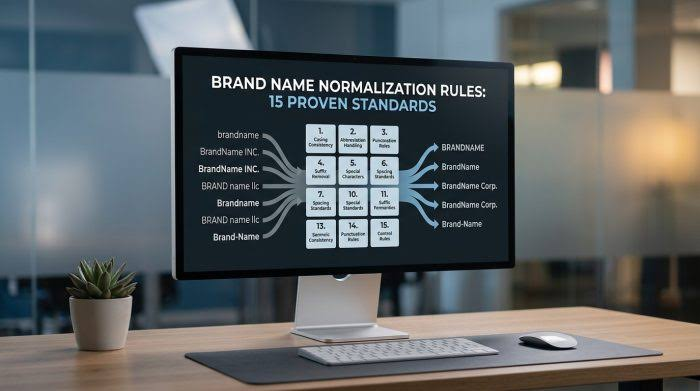
Why Are Brand Name Normalization Rules Important?
Brand name normalization is important because inconsistent names can create duplicate records and inaccurate business reports.
Imagine a company wants to determine how much revenue came from one customer. Its sales data contains the following:
- Amazon
- Amazon.com
- Amazon.com Inc.
- AMAZON
- Amazon Inc.
If the database does not recognize these as related records, the company’s reporting system may split information across several entries.
The same problem can happen with product catalogs, customer accounts, vendor lists, advertising platforms, and marketing databases.
Consistent brand data can improve:
- duplicate detection
- customer matching
- product search
- CRM accuracy
- sales reporting
- marketing segmentation
- business intelligence
- data analysis
- database maintenance
- internal search
- product categorization
Normalization can also make automation easier. Instead of creating separate logic for every possible spelling or formatting variation, systems can work with a standardized comparison value.
However, normalization must be performed carefully.
Also Read: Backtofrontshow Pricing: Complete Cost and Features Comparison
A system that is too aggressive can create a different problem by combining unrelated companies. For example, “Delta Air Lines,” “Delta Dental,” and “Delta Faucet” should not automatically be treated as one organization simply because they share the word “Delta.”
The goal is not to remove every difference.
The goal is to remove differences that do not matter for the specific data task.
How Do Brand Name Normalization Rules Work?
A brand normalization process usually starts with the original name and applies a series of controlled transformations.
Suppose a database receives this value:
“ NIKE, INC. ”
A basic normalization process may perform the following actions:
First, it removes unnecessary spaces.
“NIKE, INC.”
Next, it standardizes capitalization.
“nike, inc.”
Then it handles punctuation according to the organization’s rules.
Finally, if the database is designed for brand-level matching, it may remove the approved corporate suffix.
“nike”
The system can then compare this normalized value with its master brand database.
The final record might contain:
Original name: NIKE, INC.
Normalized key: nike
Canonical name: Nike
Entity ID: A12345
This approach separates three different concepts.
The original name tells the organization exactly what the source provided.
The normalized key makes automated matching easier.
The canonical name provides a consistent human-readable value.
This three-part structure is often more reliable than simply replacing the original name with a cleaned version.
What Are the Main Brand Name Normalization Rules?
A strong normalization process normally starts with simple and predictable rules before moving to more advanced matching.
The most common rules include:
Case Normalization
Convert letters into a consistent case for comparison.
For example:
“NIKE”
“Nike”
“nike”
can all produce the comparison value:
“nike”
Whitespace Normalization
Remove unnecessary spaces at the beginning and end of a name and convert repeated spaces into a single space.
For example:
“ New Balance ”
can become:
“New Balance”
Punctuation Normalization
Handle commas, periods, apostrophes, hyphens, and other punctuation consistently.
For example:
“Apple, Inc.”
and
“Apple Inc.”
may be treated as equivalent for matching.
Corporate Suffix Normalization
Depending on the purpose, terms such as:
- Inc.
- Incorporated
- Corporation
- Corp.
- LLC
- L.L.C.
- Ltd.
- Limited
- Co.
- Company
may be standardized or excluded from a brand-level matching key.
These rules should not be applied blindly because legal suffixes can matter when identifying separate legal entities.
Abbreviation Normalization
Common abbreviations can be mapped to approved forms.
For example:
“Corp” and “Corporation” may be treated as equivalent.
Alias Mapping
Known alternative names can be mapped to a canonical brand.
For example:
“IBM Corp.”
may map to:
“IBM”
Character Normalization
Different representations of similar characters can sometimes be standardized.
For example, straight and curly apostrophes may be treated as equivalent.
Each of these rules should be documented and tested before being applied to production data.
How Should Capitalization and Punctuation Be Handled?
Capitalization and punctuation are among the safest areas to normalize because they frequently represent formatting differences rather than differences in identity.
For example:
- Starbucks
- STARBUCKS
- starbucks
- Starbucks.
can usually be treated as equivalent for search or matching.
The system can create a lowercase comparison key such as:
“starbucks”
However, the public-facing name should normally remain:
“Starbucks”
The same principle applies to punctuation.
A company may appear as:
“Coca-Cola”
“Coca Cola”
“COCA-COLA”
Depending on the purpose of the system, the comparison key could treat the hyphen as insignificant.
But removing punctuation from every brand is not always safe.
Some punctuation is part of a recognizable brand identity. A normalization system should therefore distinguish between formatting cleanup and brand presentation.
The safest approach is usually to normalize punctuation for internal comparison while preserving the official or preferred display name separately.
How Should Company Suffixes Be Normalized?
Corporate suffixes create many duplicate-looking records.
Common examples include:
- Inc.
- Inc
- Incorporated
- Corp.
- Corp
- Corporation
- LLC
- L.L.C.
- Ltd.
- Limited
- Co.
- Company
For brand-level analysis, it may be useful to remove these terms from the normalized comparison key.
For example:
“Target Corporation”
could produce:
“target”
But this should not automatically be done for legal entity management.
Consider these two records:
“Example Holdings LLC”
“Example Holdings Inc.”
They may represent separate legal entities even though their names are almost identical.
Therefore, one of the most important brand name normalization rules is to understand the difference between brand matching and legal entity matching.
A brand database may reasonably group several legal entities under one brand.
A legal database usually should not.
This is why normalization rules should be designed according to the business purpose rather than copied from a generic template.
How Should Brand Aliases and Alternate Names Be Managed?
Brand aliases are alternative names that refer to the same brand or organization.
They can occur because of:
- abbreviations
- historical names
- informal names
- former company names
- trade names
- DBAs
- regional naming
- common customer usage
- shortened names
A normalization dictionary can store these variations.
For example:
| Input Variation | Canonical Brand |
| IBM Corp. | IBM |
| IBM Corporation | IBM |
| International Business Machines | IBM |
| IBM | IBM |
The advantage of an alias dictionary is that the system does not have to guess every time it encounters a known variation.
Once an alias has been reviewed and approved, it can be reused.
However, aliases should be verified.
A common abbreviation may refer to multiple businesses, and a historical company name may have been used by different entities at different times.
For this reason, alias mapping should ideally include an internal entity ID rather than relying only on text.
How Should Similar but Different Brand Names Be Treated?
Not every similar name should be normalized into one brand.
This is one of the most important principles in brand data management.
For example:
- Delta Air Lines
- Delta Dental
- Delta Faucet
are not automatically the same company.
Similarly:
- Apple Inc.
- Apple Records
- Apple Bank
should not be merged simply because they contain the same word.
This is where context becomes important.
A normalization system can examine additional information such as:
- industry
- website domain
- country
- address
- business identifier
- parent company
- product category
- source system
For example, if one record is associated with an airline website and another is associated with a dental insurance website, the context strongly suggests that they are different entities.
The lesson is simple: name similarity should be treated as evidence, not proof.
How Does Fuzzy Matching Fit Into Brand Name Normalization?
Fuzzy matching is useful when two names are similar but not exactly the same.
For example:
Also Read: Harouxinn: Meaning, Origin, Uses, Online Identity, and What We Know
“Starbucks”
and
“Starbuks”
have a small spelling difference.
A fuzzy matching system may identify them as possible matches.
Other examples include:
- “Wal Mart” vs. “Walmart”
- “McDonalds” vs. “McDonald’s”
- “Adobe Systems” vs. “Adobe”
- “Fed Ex” vs. “FedEx”
Fuzzy matching can be powerful, but it should not be the only normalization method.
If the matching threshold is too low, unrelated businesses may be combined.
For example:
“United Airlines”
and
“United Healthcare”
may share enough characters to look similar, but they are different organizations.
A reliable process usually uses fuzzy matching after simpler normalization rules have been applied.
It can also use additional business information before confirming the match.
For high-value records, fuzzy matching should produce a review candidate rather than an automatic merge.
How Should Original and Normalized Brand Names Be Stored?
One of the best practices in brand name normalization is to keep the original value.
Do not simply overwrite the source data.
A well-designed record might look like this:
Original Brand Name: MICROSOFT CORP.
Cleaned Brand Name: Microsoft Corp.
Normalized Key: microsoft
Canonical Brand Name: Microsoft
Legal Entity Name: Microsoft Corporation
Entity ID: 10025
This structure makes the data easier to audit.
If someone asks why two records were grouped together, the organization can see the original input and the normalization decision.
It also makes future rule changes easier.
For example, if an organization later decides that corporate suffixes should no longer be ignored, it can rebuild the matching key without losing the original data.
Preserving source values is therefore both a technical and governance best practice.
How Can Brand Name Normalization Improve CRM and Business Data?
Customer relationship management systems often contain company names entered manually by sales representatives, customer-service teams, forms, imports, and external systems.
This creates natural variation.
One employee might enter:
“Home Depot”
Another might enter:
“The Home Depot”
Another might enter:
“Home Depot Inc.”
Without normalization, the CRM could contain multiple accounts for the same business.
This can lead to:
- fragmented customer histories
- inaccurate sales reports
- duplicate outreach
- incorrect account ownership
- incomplete customer segmentation
- unreliable revenue calculations
Brand name normalization can help connect these variations.
However, CRM normalization should also consider parent companies, subsidiaries, branches, and separate customer accounts.
For example, a large enterprise may have many independent purchasing units. Automatically merging them could remove useful business information.
The best CRM approach combines normalized names with account IDs, domains, addresses, and organizational relationships.
How Does Brand Name Normalization Help E-Commerce and Product Data?
E-commerce companies often receive product information from manufacturers, suppliers, sellers, distributors, and marketplaces.
Brand names can therefore appear in many forms.
For example:
- Sony
- SONY
- Sony Corporation
- Sony Electronics
- Sony Corp.
If each version becomes a separate brand value, customers may see duplicate brand filters or fragmented product reports.
A normalized brand field can help create a cleaner catalog.
However, e-commerce systems should distinguish between a brand, manufacturer, seller, and parent company.
These terms can describe different entities.
A product may belong to one brand, be manufactured by another organization, and be sold by a third-party retailer.
Normalization should not erase these relationships.
Instead, it should make each relationship easier to understand.
How Should Brand Name Normalization Work for SEO and Search?
Brand normalization can also improve search systems.
Users may search for a brand using different capitalization, punctuation, abbreviations, or spacing.
For example:
“nike shoes”
“NIKE shoes”
“nike inc shoes”
A search system can use normalized values to understand that these searches are related.
For internal website search, normalization can improve matching between user queries and stored brand data.
For SEO, however, businesses should not create unnatural pages simply to repeat variations of a brand name.
A professional SEO strategy should use the natural brand name while providing useful, accurate information.
Search engines are designed to understand variations and related concepts, so excessive keyword repetition is unnecessary.
The exact keyword “brand name normalization rules” should also be used naturally rather than repeated in every paragraph.
What Is the Best Workflow for Brand Name Normalization?
A reliable workflow can be organized into several practical stages.
First, collect the original brand names from all important sources.
Second, preserve the original values.
Third, clean obvious formatting issues.
Fourth, create normalized comparison keys.
Fifth, apply approved abbreviation and suffix rules.
Sixth, check the alias dictionary.
Seventh, compare the result with a trusted master brand list.
Eighth, use contextual or fuzzy matching for unresolved records.
Ninth, assign a confidence level.
Tenth, send uncertain records for human review.
Eleventh, save approved mappings so they can be reused.
This workflow is more reliable than attempting to solve every record with one large matching formula.
It also allows organizations to improve their rules gradually.
What Are the Common Mistakes in Brand Name Normalization?
Several mistakes can reduce the quality of a normalization project.
The first mistake is removing too much information.
If a system deletes every word that looks unnecessary, different organizations may become indistinguishable.
The second mistake is relying entirely on fuzzy matching.
Fuzzy algorithms can identify similarities, but similarity does not guarantee identity.
The third mistake is overwriting original names.
This removes valuable source information and makes auditing difficult.
The fourth mistake is ignoring legal and organizational structures.
A parent company, subsidiary, brand, and DBA may all have different identities.
The fifth mistake is failing to maintain an alias dictionary.
Without a controlled mapping system, the same naming problem may be solved differently by different teams.
The sixth mistake is failing to test false matches.
A system should be tested not only on names that should match but also on names that must remain separate.
The seventh mistake is treating normalization as a one-time task.
Businesses rename, merge, acquire, and restructure over time. Brand data must therefore be maintained.
How Should Companies Test Brand Name Normalization Rules?
Testing should include both positive and negative examples.
Positive examples are names that should be recognized as the same brand.
For example:
- Nike
- NIKE
- Nike Inc.
- Nike, Inc.
Negative examples are names that look similar but should remain separate.
For example:
- Delta Air Lines
- Delta Dental
A good test dataset should include:
- capitalization differences
- punctuation differences
- extra spaces
- abbreviations
- legal suffixes
- aliases
- misspellings
- historical names
- similar brand names
- subsidiaries
- parent companies
- international names
The organization should then measure the results.
Important measurements include match accuracy, false-match rate, unmatched rate, duplicate reduction, and manual-review rate.
Testing should be repeated whenever major rules change.
What Are the Best Practices for Brand Name Normalization?
The strongest brand normalization systems follow a few simple principles.
Keep original values.
Create separate normalized values.
Use canonical brand names.
Maintain unique entity IDs.
Create a controlled alias dictionary.
Use simple deterministic rules first.
Use fuzzy matching only when appropriate.
Add business context to difficult matches.
Set confidence thresholds.
Require human review for uncertain high-value matches.
Keep an audit history.
Review normalization rules regularly.
Most importantly, do not try to make every name identical.
The purpose of normalization is to make data comparable while preserving meaningful differences.
A useful normalization system should answer two questions:
“What differences can safely be ignored?”
and
“Which differences could indicate a different business?”
The second question is often more important than the first.
Also Read: Tasyyblack: A Complete Guide to Urban Fashion and Style
FAQs About Brand Name Normalization Rules
1. Are brand name normalization rules the same for every industry?
No. A retail product database may need different rules from a financial, legal, healthcare, or CRM database. The normalization strategy should match the purpose and risk level of the data.
2. Can brand name normalization be performed automatically?
Yes. Basic formatting changes can usually be automated, while complex entity matches may require additional data, confidence scoring, or human review.
3. What is a canonical brand name?
A canonical brand name is the preferred standardized name used to represent a brand in a master data system. It provides a consistent value for display, reporting, or data management.
4. How can companies prevent incorrect brand-name matches?
Companies can combine name normalization with unique identifiers, websites, industries, addresses, parent-company information, and human review. This is safer than relying on name similarity alone.
5. Is brand name normalization useful for small businesses?
Yes. Even a small business can benefit when it manages customer lists, suppliers, products, marketing data, or multiple software systems. Starting with simple rules can prevent duplicate and inconsistent data as the business grows.
Conclusion
Brand name normalization rules help businesses turn inconsistent brand and company names into clean, reliable, and usable data. By standardizing capitalization, spacing, punctuation, abbreviations, aliases, and approved business suffixes, organizations can reduce duplicates and improve search, reporting, CRM, e-commerce, and data analysis.
The most important point is to normalize carefully. Similar names do not always represent the same business, so trusted identifiers, business context, and human review may be needed for complex matches. Keeping the original name alongside the normalized and canonical values also makes the data easier to audit and manage.
When these practices are applied consistently, brand name normalization becomes a strong foundation for accurate and trustworthy business data.